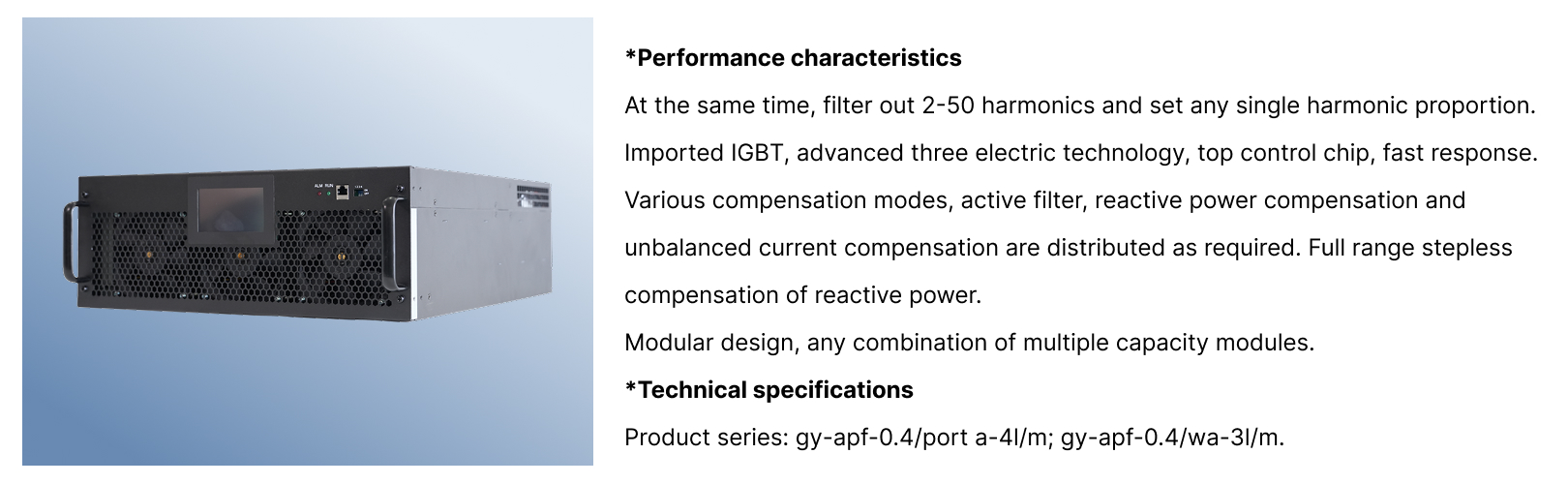
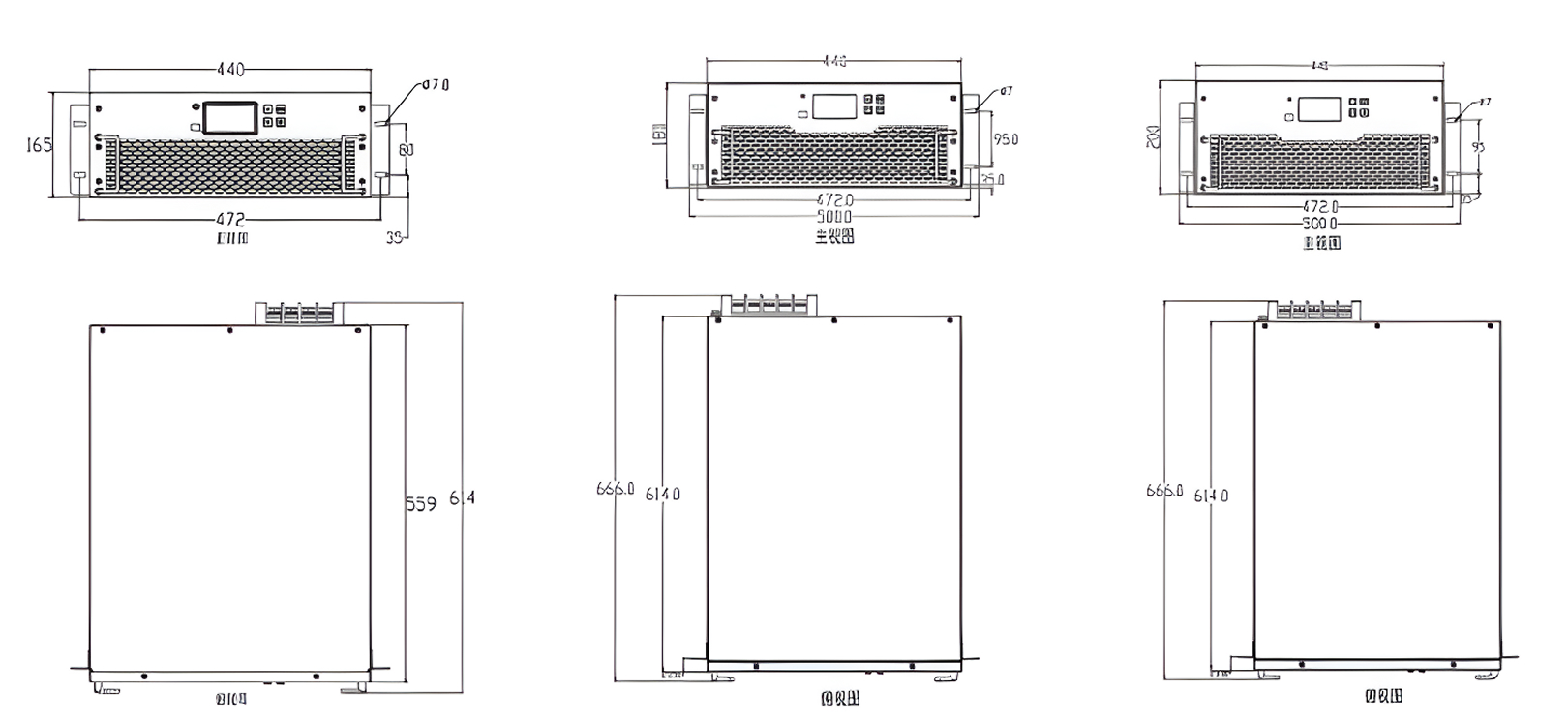
Core Concept and Key Technology
An Active Power Filter is an electronically controlled system that mitigates undesirable harmonic currents, balances load currents, and compensates for reactive power in real time. Unlike passive filters that rely on fixed inductors, Capacitors, and resistors tuned to specific harmonic frequencies, APFs use power electronics—typically IGBT (Insulated Gate Bipolar Transistor) switches—to synthesize compensating currents that cancel unwanted components.
At the heart of an APF is a high‑speed Controller paired with advanced modulation techniques. The controller continuously samples load currents, decomposes them into fundamental and harmonic components, and computes the necessary compensating waveform. This compensating waveform is then generated by the power converter using PWM (Pulse Width Modulation) and injected into the line in precise opposition to the harmonic content.
Several attributes distinguish modern APFs:
Harmonic Filtering Capability: Most industrial APFs target a broad spectrum ranging from the 2nd to the 50th harmonic, enabling comprehensive suppression of distortion generated by various nonlinear loads.
Adaptive Harmonic Proportion Setting: Advanced systems allow engineers to configure specific harmonic proportions, enabling more tailored compensation that aligns with regional grid codes or plant requirements.
Fast Dynamic Response: With imported IGBT modules and high‑performance control chips, APFs can respond to changing load conditions within microseconds, minimizing transient distortion.
Product Architecture and Performance Evaluation
Modular Design
A defining characteristic of industrial APFs is modular architecture. Modules can be combined to scale capacity incrementally, enabling tailored solutions for applications from localized machine loads to facility‑wide power‑quality systems. Each module typically contains:
Power conversion stage with IGBT bridge
DC link capacitor bank
Current and voltage sensors
High‑speed digital controller
Isolation and protection circuitry
Modules operate in parallel under master control logic, allowing stepless compensation across a wide kVAR range and ensuring redundant operation in multi‑module configurations.
Compensation Modes
Active Power Filters support multiple compensation modes:
Active Harmonic Filtering: Removes or significantly reduces harmonic currents injected by nonlinear loads.
Reactive Power Compensation: Supplies or absorbs reactive power dynamically, improving overall system power factor.
Unbalanced Current Compensation: Balances phase currents in three‑phase systems, reducing neutral conductor stress and equipment heating.
These modes can operate concurrently, enabling more comprehensive power quality improvement than traditional solutions.
Materials and Manufacturing
Critical to APF performance are the quality of power semiconductors, passive components, and control hardware:
IGBT Modules: The choice of IGBT affects switching speed, thermal behavior, and electrical efficiency. High‑grade modules with low switching losses yield lower heat generation and higher lifetime.
Control Electronics: High‑precision ADCs (Analog‑to‑Digital Converters) and DSP (Digital Signal Processors) or FPGA (Field Programmable Gate Array) platforms support fast sampling rates and accurate harmonic decomposition.
Passive Components: High‑density DC link capacitors and low‑loss inductors underpin stable operation and mitigate voltage ripple.
Manufacturing precision influences system reliability. Automated assembly, rigorous calibration, and environmental stress testing ensure consistent performance under industrial conditions.
Factors Affecting Quality and Performance
Several factors influence the effectiveness of an Active Power Filter in practical deployment:
System Load Characteristics
APFs are designed to respond to dynamic loads that vary in time. A system dominated by rapidly changing loads, such as welding equipment or multi‑axis CNC machines, demands an APF with faster response and higher sampling fidelity.
Harmonic Spectrum and Severity
The degree and order of harmonics present determine the sizing and configuration of the APF. Higher‑order harmonics require filters capable of broader frequency coverage and greater instantaneous current output.
Environmental Conditions
Industrial environments often expose APF hardware to temperature extremes, vibration, and airborne contaminants. Proper enclosure ratings (e.g., IP54 or higher) and thermal management measures (such as forced air cooling) are necessary to maintain long‑term reliability.
Installation and Commissioning
Incorrect measurement point placement or inadequate grounding can compromise APF performance. Professional commissioning, including thorough system characterization and tuning of control parameters, ensures optimal harmonics mitigation.
Supply Chain and Supplier Evaluation
Selecting an APF supplier is a strategic decision with long‑term operational implications. Key factors include:
Technical Compliance and Testing Standards: Suppliers should provide products compliant with relevant international standards (e.g., IEEE 519, IEC 61000‑4 series) and furnish third‑party test reports demonstrating harmonic mitigation performance, immunity, and safety metrics.
Engineering Support: High‑quality suppliers offer pre‑installation assessment, system modeling, and post‑deployment support to optimize APF configuration and maintain long‑term performance.
Component Traceability: Full documentation of component sources and manufacturing processes enhances confidence in product longevity, especially in critical power‑centric applications.
Customization Capabilities: Some applications require tailored solutions—whether extended harmonic range, unusual voltage levels, or integration with advanced energy management systems. Supplier flexibility is essential.
After‑Sales Service: Warranty terms, spare parts support, and availability of trained service engineers reflect a supplier’s commitment to product lifecycle performance.
Common Challenges and Industry Pain Points
Despite the advantages of APFs, several practical challenges emerge in industrial contexts:
Resonance and Filter Interaction
When APFs are deployed in combination with passive filter banks or capacitor groups, unintended resonance can occur if system impedance characteristics are not fully understood. Thorough power system analysis helps avoid such conditions.
Cost vs. Benefit Tradeoff
High‑capacity APFs represent a significant capital investment. Engineering teams must justify the cost in terms of improved power factor, reduced energy losses, lower utility charges, and extended lifespan of connected equipment.
Integration Complexity
Legacy systems often lack sufficient monitoring instrumentation, making system characterization and APF tuning more labor‑intensive and requiring additional metering and control integration.
Application Scenarios and Use Cases
APFs are deployed across diverse industrial and commercial environments:
Manufacturing Facilities: On production lines with multiple VFDs and servo systems, APFs reduce harmonics and improve throughput by reducing line disturbances.
Data Centers: Sensitive computing loads require stable power profiles; APFs help mitigate input current distortion and lower cooling loads caused by inefficient power draw.
Renewable Energy Integration: Inverters in solar and wind installations introduce harmonics; APFs ensure compliance with grid codes and smooth integration.
Healthcare Facilities: Sensitive diagnostic equipment benefits from improved power quality, reducing noise and calibration errors caused by voltage distortion.
Current Trends and Future Directions
The field of active power filtering is shaped by emerging technologies and evolving industry priorities:
Digital and AI‑Assisted Control
Next‑generation APFs incorporate digital twin modeling and machine learning to anticipate load changes and pre‑emptively adjust compensation strategies. This advances beyond real‑time reaction into predictive control.
Integration with Energy Management Systems (EMS)
APFs are increasingly integrated into comprehensive EMS platforms that optimize energy consumption, manage reactive power scheduling, and coordinate with distributed energy resources such as batteries and solar.
Enhanced Diagnostics and Predictive Maintenance
Embedded sensors and analytics allow APFs to self‑diagnose component degradation, raising alerts before performance impacts occur.
Grid‑Interactive Power Quality Resources
As grids evolve toward higher distributed generation and bidirectional power flows, APFs may play a role as grid‑support devices—injecting or absorbing reactive power dynamically to assist voltage regulation.
Frequently Asked Questions (FAQ)
Q: How does an APF differ from a passive filter?
A: Passive filters use fixed inductance, capacitance, and resistance to target specific harmonics, and their performance is limited under variable load conditions. APFs use active power electronics to adapt in real time and compensate a broader range of harmonics.
Q: What types of loads benefit most from APFs?
A: Loads with significant nonlinear characteristics—such as VFD‑driven motors, large UPS systems, and power conversion equipment—benefit most due to their high harmonic distortion content.
Q: Is APF technology suitable for low‑voltage, high‑current systems?
A: Yes. Modern APFs can be scaled with modular designs to support high‑current, low‑voltage installations commonly found in manufacturing and commercial power distribution.

 English
 Español
 Portugues
 Pусский
 Français
 Deutsch
 日本語
日本語
 한국어
한국어
 العربية
 Italiano
 Nederlands
 Svenska
 Polski
 Türk dili
 हिन्दी
 Indonesia
 Melayu
 dansk
dansk
 Magyar
 қазақ
қазақ
 বাংলা
বাংলা
 עִברִית
 čeština
 українська
 беларускі
 Filipino
 Suomalainen
 اردو
اردو
 հայերեն
 български
 galego
 नेपाल
नेपाल
 euskara
 Shqipëria
 Malagasy
 Башҡорт
 Türkmenler
 Ilocano
 Нохчийн



 Whatsapp
 Telefon